The Breadcrumbs Project

The Breadcrumbs ProjectThe Breadcrumbs ProjectThe Breadcrumbs Project

The Breadcrumbs Project

The Breadcrumbs ProjectThe Breadcrumbs ProjectThe Breadcrumbs Project

THE FIRST MANUPORT DATABASE: The International Manuport Register (IMR)

THE FIRST MANUPORT DATABASE: The International Manuport Register (IMR)THE FIRST MANUPORT DATABASE: The International Manuport Register (IMR)THE FIRST MANUPORT DATABASE: The International Manuport Register (IMR)

THE FIRST MANUPORT DATABASE: The International Manuport Register (IMR)

THE FIRST MANUPORT DATABASE: The International Manuport Register (IMR)THE FIRST MANUPORT DATABASE: The International Manuport Register (IMR)THE FIRST MANUPORT DATABASE: The International Manuport Register (IMR)

About The Breadcrumbs Project

The Breadcrumbs Project is an independent research initiative based in Muxía, Galicia.


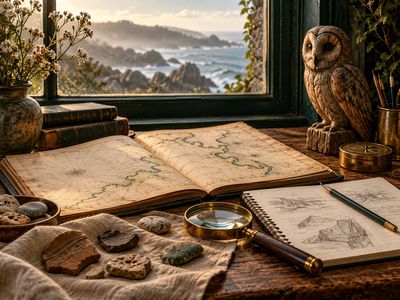
We investigate the past through historical maps, inscriptions, architecture, objects and the landscapes around them. Our work follows connections across places and centuries, asking fresh questions about the histories we have inherited.


Founded by Charles Chambers, the project brings together field observation, archival research and publishing. We develop ideas, document their evidence, and invite others to help follow the trail.
Current Research

The Industrial Ecosystem Test

The Pebble Problem — The Worry Stone Project
The Industrial Ecosystem Test

What did it take to build this?


An investigation into the materials, labour, tools, transport, and fuel required to construct monumental stone buildings. Beginning with sites in Galicia, the project asks whether the surviving industrial evidence supports their proposed construction histories.


Learn more

Grandimirum GIS Project

The Pebble Problem — The Worry Stone Project
The Industrial Ecosystem Test

 Mapping an ancient question.


Combining historical cartography, Roman itinerary distances, archaeological records, and field observations to test the Muxía–Camariñas hypothesis for ancient Glandimiro. GIS brings these layers together so competing locations can be compared systematically.


Learn more

The Pebble Problem — The Worry Stone Project

The Pebble Problem — The Worry Stone Project

The Pebble Problem — The Worry Stone Project


Can touch leave a history in stone?

A study of grooved and polished pebbles collected along Muxía’s shoreline. Through systematic recording, tactile experiments, and specialist consultation, the project investigates whether their distinctive surfaces reflect repeated human handling, natural processes, or both.

Learn more

Muxía on Maps Through History

Kuélap and the Atlantic Question
Muxía on Maps Through History

 Tracing Muxía across centuries of maps: its changing names, coastal landmarks, and the cartographers who recorded them. 


Learn more

The Caligula Milestone

Kuélap and the Atlantic Question
Muxía on Maps Through History

 Examining a Roman milestone from San Fins de Sales and the roads, settlements, and imperial messages of first-century Galicia. 


Learn more

Kuélap and the Atlantic Question

Kuélap and the Atlantic Question

 Investigating the proposed connections between Galicia’s castro culture and the monumental settlements of the Chachapoya through architecture, chronology, and material evidence. 

Learn more

Discussion Papers

DID THE CELTS REACH THE AMERICAS

A circulating discussion paper testing an Atlantic-to-Pacific migration hypothesis. 

  • -Did Atlantic Iberian / Irish Celtic groups reach the Americas?
  • -Did such migrants pass the Strait of Magellan before Magellan?
  • -Did an Atlantic group build or transform Kuélap?
Get the discussion paper
THE PEBBLE PROBLEM

When does a manuport become an artefact?

  • -If an ancient person selected a naturally formed stone, carried it for years, and repeatedly handle
  • -Could archaeologists be overlooking an entire category of ancient human behaviour because they rely
  • -If twenty independent participants repeatedly identify the same naturally formed stones as having u
Get the discussion paper

About Charles A. Chambers, CCNA, MCP

Independent Researcher & Author


Founder of The Breadcrumbs Project, investigating Atlantic history, archaeology, pilgrimage, and the forgotten stories hidden in plain sight.

Technologist & Systems Builder

 More than three decades in networking, systems administration, data centers, and emerging technology — including work for the U.S. Navy and U.S. Department of Education.     

From Louisiana to the Atlantic Edge

 A U.S. Army veteran and Southeastern Louisiana University graduate who eventually made Muxía, Galicia, the base for a second career in writing, research, and discovery. 

Publications

The Forgotten Origins of the Camino de Santiago


The Camino is far older than anyone suspects…

Charles Chambers explores the pilgrimage’s deeper history through the landscap

Explore the book

Publications

The Signature Beneath the Shard

A fragment of pottery. A stone worn smooth. A question beneath the soil.


Beginning with discoveries on Monte Corpiño and the 

Explore the book

Publications

Latin America

Finding Where Exactly the Romans Went When They Disappeared from History


What if the maps preserve a story the chronicles over

Explore the book

Follow us on social for updates.

Contact Us

Drop us a line!

This site is protected by reCAPTCHA and the Google Privacy Policy and Terms of Service apply.

Copyright © 2026 The Breadcrumbs Project - All Rights Reserved.

Powered by

This website uses cookies.

We use cookies to analyze website traffic and optimize your website experience. By accepting our use of cookies, your data will be aggregated with all other user data.

Accept